Enterprise Vulnerability Management Platform
Scan.
Correlate.
Remediate.
PMAP unifies 30 vulnerability scanners (Tenable, Qualys, Rapid7, plus DAST, SAST and SCA) into one multi-tenant platform. A correlation engine deduplicates every finding, SLA-driven workflows route remediation, and live dashboards map risk to assets, owners and reports.
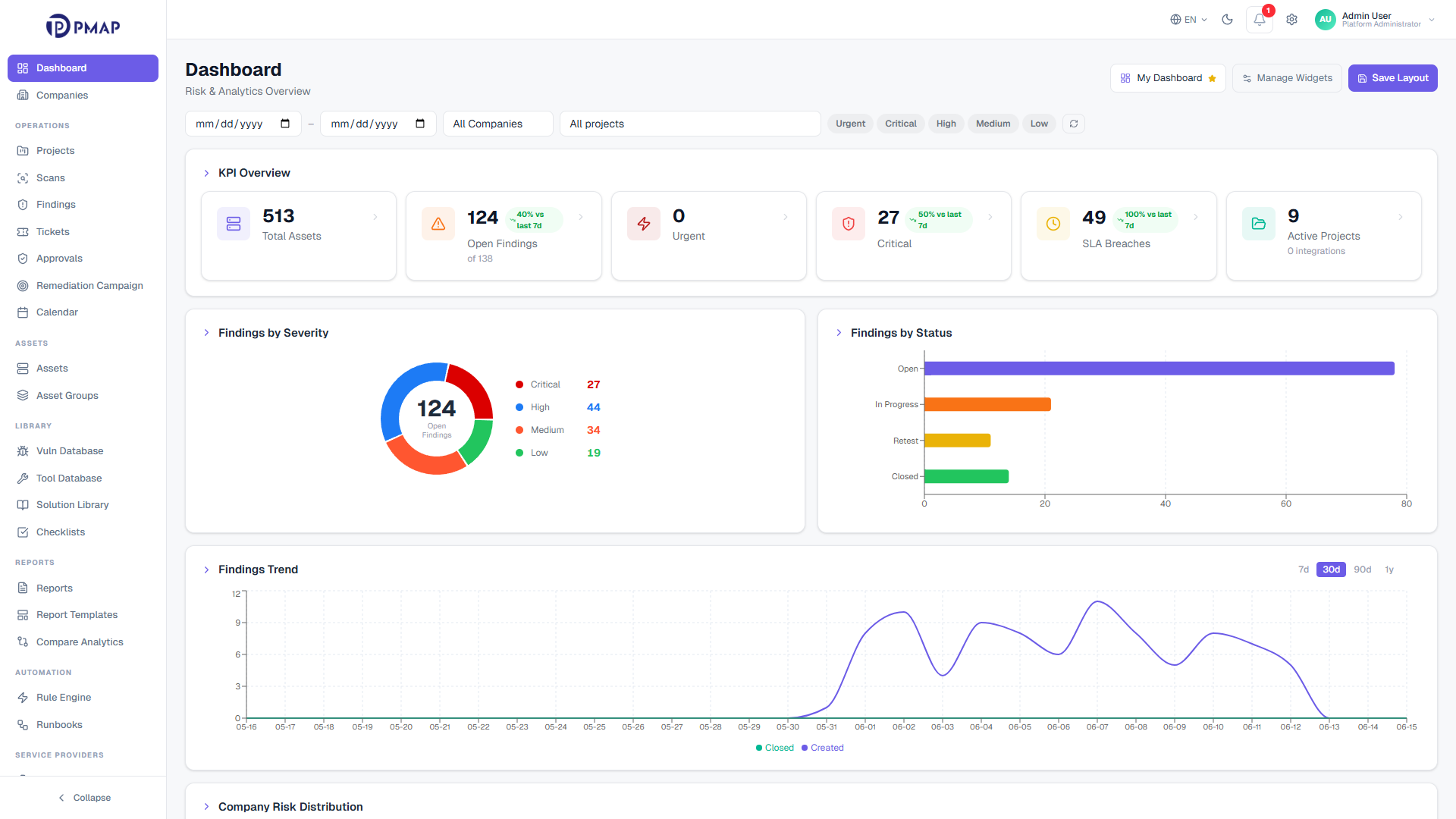
Unified Vulnerability Operations
Run enterprise vulnerability management on one platform with PMAP
PMAP brings multi-vendor scanning, finding correlation and SLA-driven remediation into a single console for enterprise security teams. A correlation engine normalizes and deduplicates results from 30 scanners, risk scoring ranks every asset and finding, and an audit trail records every status change. Explore the full platform capabilities and see how PMAP scales across your holding and its subsidiaries.
From scanner output to closed finding
One pipeline that turns raw scanner output into resolved findings
Each scanner result enters PMAP once, gets correlated against what already exists, then moves through policy and SLA control until it is closed. One path from ingest to remediation, whatever scanner found it.
-
Ingest
Pull results from 30 connectors over remote scan APIs, scheduled imports or file upload, across VM, DAST, SAST, SCA, network discovery and mobile.
-
Correlate
Deduplicate every result against what already exists, then enrich it with CVE, CWE, CVSS and MITRE ATT&CK.
-
Prioritize
Apply severity, ownership and SLA the moment a finding lands, with a four-eye gate on risky changes.
-
Remediate
Drive each finding to its deadline and into Jira, ServiceNow or ManageEngine, then report it closed.
Any scanner connects. Every finding is correlated, governed and resolved on one shared inventory and a complete audit trail.
Three product pillars under one platform
Orchestrate, Correlate and Remediate, built as three pillars that grow with your estate
PMAP runs across a holding company and its subsidiaries from a single tenant boundary, so every scan, finding and report stays scoped to the right organization. Each pillar carries the depth a security team uses every day and the evidence an auditor asks for at the end.
Run scans across 30 vendors and 9 categories
PMAP Orchestrate
Launch, pause, resume and stop scans on Nessus, Qualys VMDR, Rapid7 InsightVM, Tenable SC and IO and your DAST vendors without leaving the platform. Campaign mode fires one scan per selected integration in a single call, so a multi-vendor assessment wave starts together and reports together.
- Remote scan controls and live 30-second status sync per vendor
- Campaign launch that spawns one scan per integration with asset targeting
- Scan coverage and wave matrix that expose blind spots per asset
Match, enrich and govern every finding
PMAP Correlate
Smart Match resolves each finding through a four-stage pipeline that runs CVE exact first, then scanner plugin key, then fuzzy title, then manual fallback, returning a confidence score and a match reason on every result. PMAP never trusts vendor severity directly. A configurable threshold and the rule engine decide the effective severity before a finding reaches an analyst queue.
- Four-stage Smart Match with confidence score and CVE, CWE and CVSS backfill
- Automatic reopen that keeps the original status history intact
- Recurrence and wave tracking that show how often each issue returns
Govern findings to a deadline and prove it
PMAP Remediate
A four-level SLA waterfall resolves the effective deadline from project, company, admin and built-in defaults, then three-tier escalation contacts route overdue findings up the on-call chain. A four-eyes gate holds risk acceptance and closure until a second reviewer signs off, and signed reports carry a SHA-256 hash and a QR verification link that recipients check without a PMAP account.
- Four-level SLA waterfall with three-tier escalation routing
- Four-eyes approval inbox for risk acceptance and closure
- PDF, DOCX and HTML reports with integrity signing and public share tokens
Built for enterprise scale
PMAP by the numbers
Three data points that describe how PMAP unifies vulnerability management across scanners, one data model and multi-tenant governance.
PMAP imports from every scanner to the same normalized standard, in real time over API sync or on a schedule. Integrity is enforced across the pipeline, and multi-tenant isolation keeps every subsidiary's data separate.
-
Hover for details
30Vendor connectors and importers
One platform, every scanner your program runs
One platform unifies 30 vendor connectors across 9 categories, covering vulnerability scanners, DAST, SAST, SCA, ITSM and CI/CD. Results flow in over live API sync or scheduled imports, every finding is mapped to an asset and owner, and the correlation engine deduplicates across vendors.
Tenable Qualys Rapid7 DAST, SAST and SCAExplore integrations -
Hover for details
48Product domains, one data model
Findings, assets, projects and reports in one model
PMAP spans 48 backend domains across finding lifecycle, assets, scanning, reporting, automation and tenancy, all on one normalized model. A finding moves from import to remediation without ever leaving the platform.
Findings Assets Projects Reports RunbooksExplore the platform -
Hover for details
Multi-tenant
One platform for the whole group and every unit
A holding company and its subsidiaries share one platform with scoped data, a 10 by 6 role matrix, SLA thresholds and four-eye approvals. Group-level views roll findings and risk up across the entire organization.
RBAC SLA Approvals Audit trail LDAP and MFASee access controls
Figures describe the PMAP platform across integrations, data model and multi-tenant governance.
One platform, end-to-end vulnerability management
A vulnerability management platform for the modern enterprise
For enterprise security teams, every step of vulnerability management happens inside one console: building the asset inventory, prioritizing findings by real risk, and proving progress to auditors and leadership. Asset data, findings and reports share the same model and the same tenant hierarchy, so your team never reconstructs context as the work moves forward.
Correlate and dedupe
Merge duplicate findings across every scanner into one record.
SLA-driven workflows
Route remediation by risk with deadlines and approvals.
Audit-ready reporting
Signed PDF, DOCX and HTML reports with full status history per tenant.
See every asset
Asset inventory and risk scoring
Build a live inventory of hosts, IPs, web applications and code repositories, each enriched with ownership, business context and a risk score. Wave matrices, asset groups and IP/CIDR scopes keep large estates organized as they grow.
Learn moreGovern every tenant
Multi-tenancy, RBAC and SLA
Separate a holding company from its subsidiaries with scoped data, teams and a 10 by 6 role matrix. SLA thresholds, four-eye approvals and audit trails keep governance tight across every business unit.
Learn moreProve the progress
Reporting, analytics and dashboards
Generate signed PDF, DOCX and HTML reports on a schedule, share them through secure tokens, and track KPIs, SLA compliance and risk trends on configurable dashboards. Every status change is recorded for audit.
Learn more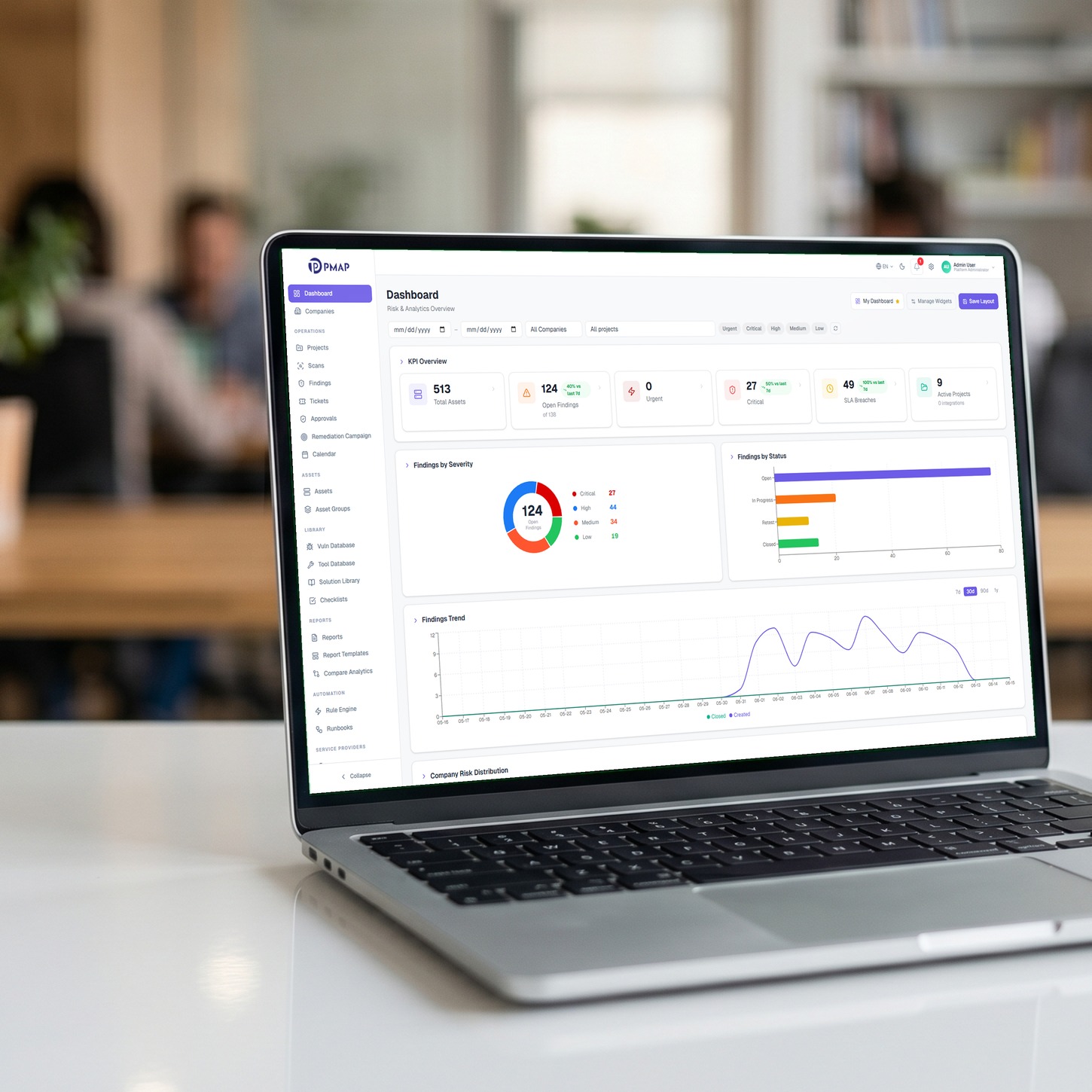
Explore PMAP
Go deeper into the PMAP platform
The PMAP Blog is where our team writes up how enterprise vulnerability programs actually run. Every post starts from real practice, then turns the workflows, integrations and prioritization logic behind it into something your team can read and reuse.
Expect deep dives on multi-vendor correlation, walkthroughs of SLA-driven remediation, and practical notes on reporting and multi-tenant governance. No product pitch and no recycled headlines, just field notes from the work teams run today.
Capabilities
Explore the PMAP capability set
See how multi-vendor scan orchestration, finding correlation, the vulnerability lifecycle, asset risk and reporting fit together in one platform.
View capabilitiesPlatform
See how PMAP works end to end
Follow a single finding from multi-vendor ingest through correlation and deduplication into prioritization, ownership and remediation.
How it worksResources
Datasheets and guides for vulnerability management teams
Browse PMAP datasheets and practical guides that cover scan orchestration, finding lifecycle, identity and reporting in depth.
Browse resourcesFrequently asked questions about the PMAP vulnerability management platform
What is a vulnerability management platform?
A vulnerability management platform unifies the work of importing scan results, correlating and deduplicating findings, prioritizing them by risk and driving remediation inside one console. It replaces a stack of point tools (separate scanners, spreadsheets, ticket queues) with one normalized data model. Built for multi-tenant enterprises from the ground up, PMAP keeps assets, findings and reports under one source of truth.
How is PMAP different from a single scanner like Tenable or Qualys?
A scanner finds vulnerabilities on the assets it covers. PMAP sits above your scanners: it imports results from 30 vendor connectors across VM, DAST, SAST and SCA, deduplicates them so one real issue is one finding, and then manages the full lifecycle with SLA, ticketing and reporting. PMAP is deliberately positioned alongside your scanners rather than against them. Teams use PMAP to unify and act on what every scanner surfaces.
Which scanners and tools does PMAP integrate with?
PMAP ships 30 vendor connectors across 9 categories: vulnerability management (Tenable, Qualys, Rapid7), DAST, SAST and SCA, plus ITSM and CI/CD systems such as Jira, ServiceNow, GitLab and Jenkins. The same model ingests network, web, code and cloud findings, so your team works one workflow regardless of where a finding originates.
Is PMAP multi-tenant?
Yes. PMAP is built for a holding company and its subsidiaries. Each tenant has scoped data, teams and a role matrix, while group-level views roll results up across the whole organization. SLA thresholds, four-eye approvals and audit trails keep governance consistent across every business unit.
How does PMAP handle reporting and audit?
PMAP generates signed PDF, DOCX and HTML reports on demand or on a schedule, and shares them through secure tokens with external stakeholders. Every status change, approval and import is recorded in an audit trail, and dashboards track KPIs, SLA compliance and risk trends. The same mechanisms apply whether work happens in one tenant or across a managed, multi-tenant engagement.