Services & PMAP Capabilities

SOC investigation platform depth meets incident response expertise.

One vendor delivers the platform, the investigators and the chain of custody, so the response team you call shows up with the tooling already in their hands. Triage. Detect. Respond.

  • Windows · Linux · macOS · Cloud · Identity
  • On-prem · Cloud · Air-gapped
  • Privia DFIR practice

One engagement, three promises

Why teams bring PMAP in rather than stitching tools and consultants together.

Most security organisations end up running an investigation across three separate vendors: a forensic tool, an incident response consultancy and a detection content provider. PMAP compresses those three roles into a single accountable engagement with one platform, one practice and one evidence trail.

  • Promise 01

    Forensic-grade platform

    A purpose-built SOC investigation platform that collects artifacts across endpoints, cloud and identity, transports them under mTLS, and stores them in an immutable case vault. Built so the evidence captured on day one is the same evidence reviewed in week six.

    • Cross-OS agent
    • Immutable case vault
    • mTLS transport
    Explore the PMAP platform
  • Promise 02

    Investigator-led response

    Privia's incident response practice runs the engagement on the same platform you keep. Investigators apply established PMAP workflows rather than learning your tooling under incident pressure.

    • Privia DFIR practice
    • Established playbooks
    • On-call investigators
    Meet the response practice
  • Promise 03

    Evidence that holds up

    Every artifact carries a verifiable chain of custody, hashed at collection, transported under mTLS, sealed in the case vault and mapped to MITRE ATT&CK in the finished report. Designed for boardroom review and external scrutiny alike.

    • Hash chain at source
    • MITRE ATT&CK mapped
    • Boardroom-ready report
    See chain of custody by design

From scanner output to closed finding

One pipeline that turns raw scanner output into resolved findings

Each scanner result enters PMAP once, gets correlated against what already exists, then moves through policy and SLA control until it is closed. One path from ingest to remediation, whatever scanner found it.

  1. Ingest

    Pull results from 30 connectors over remote scan APIs, scheduled imports or file upload, across VM, DAST, SAST, SCA, network discovery and mobile.

  2. Correlate

    Deduplicate every result against what already exists, then enrich it with CVE, CWE, CVSS and MITRE ATT&CK.

  3. Prioritize

    Apply severity, ownership and SLA the moment a finding lands, with a four-eye gate on risky changes.

  4. Remediate

    Drive each finding to its deadline and into Jira, ServiceNow or ManageEngine, then report it closed.

Any scanner connects. Every finding is correlated, governed and resolved on one shared inventory and a complete audit trail.

Four layers, one platform

The work splits into four layers so nothing gets re-keyed between scan and close.

PMAP runs as four connected layers (ingest, correlate, prioritize and remediate). A finding is created once, enriched once and tracked across every later scan wave, so the same record carries its history instead of being rebuilt at each step.

Explore PMAP

Group scans into named, time-boxed assessment runs and let PMAP keep the inventory honest. Every active integration is swept every five minutes, vendor scans that exist remotely but not yet in PMAP are adopted automatically, and the raw vendor payload is archived for replay.

This layer includes:

  • Assessment runs with gap-free sequential run numbers per project
  • Orphan adoption sweep every five minutes, plus a delete blocklist that never re-adopts
  • File import for Nmap XML, Masscan, Nuclei JSONL, SARIF 2.1 and Nessus XML
  • Raw scanner payloads archived to MinIO for audit and replay

Artifacts and detector library

A curated artifact and detector library, tuned for parity across surfaces.

Forensic depth is set by what an investigator can actually pull from a host or tenant. The artifact spectrum below describes the categories PMAP ships with: host operating systems, cloud workloads, container layers and the network in between.

  • Windows

    Built around the artifacts modern Windows intrusions leave behind: registry hives, event logs, scheduled tasks and process telemetry. Configured for both endpoint estates and Windows server fleets.

    • Registry hives and transaction logs
    • Windows event log set
    • Prefetch and Amcache
    • Scheduled tasks and services
    • Volatile memory image
    • Browser and user-shell artifacts
  • Linux

    Coverage tuned for both interactive Linux workstations and server fleets, including systemd-driven persistence, audit logging and kernel-level evidence sources commonly missed by Windows-centric tooling.

    • systemd unit and timer artifacts
    • auditd and journald logs
    • Shell histories and dotfiles
    • Cron and at-job persistence
    • Process and network state
    • Package and kernel module inventory
  • macOS

    First-class macOS forensic depth covering Unified Logs, launch agents and the persistence locations that drive macOS-targeted intrusions. Built for engineering laptop fleets and developer-heavy estates.

    • Unified Log extraction
    • Launch agents and daemons
    • TCC and consent records
    • Quarantine and gatekeeper events
    • Persistence locations across user domains
    • Volatile memory image
  • Cloud

    API-native collection across the major cloud and SaaS providers, capturing identity events, admin actions and workload telemetry as forensic-grade artifacts rather than transient log queries.

    • AWS CloudTrail and Config snapshots
    • Azure activity and sign-in logs
    • GCP audit and admin events
    • M365 unified audit log
    • Workspace admin and login events
    • Identity provider session data
  • Container

    Forensic coverage of containerised workloads, covering runtime state, image inventory and the orchestration plane that decides what runs where. Built for Kubernetes-heavy estates and managed container platforms.

    • Kubernetes audit events
    • Container runtime state
    • Image and layer inventory
    • Pod and namespace inventory
    • Service account token usage
    • Workload identity bindings
  • Network

    Lateral movement reconstruction depends on network evidence as much as host artifacts. Captures the packet, flow and authentication views needed to draw an attacker's path across the estate.

    • Packet capture imports
    • Flow and connection records
    • DNS and proxy telemetry
    • Authentication and Kerberos events
    • Firewall and edge device logs
    • VPN session attribution

Use cases

Three scenarios, one operator workflow.

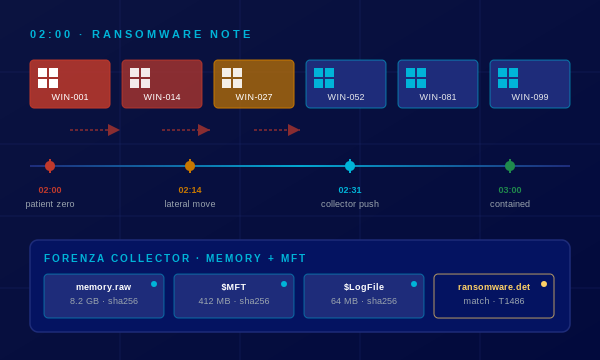
Windows fleet timeline showing patient zero, lateral spread, collector push and memory capture during a ransomware triage.

Scenario 01

Ransomware Triage

A ransomware note lands on a Windows fleet at 02:00. Operators push the PMAP collector to every host, pull memory and NTFS journals over mTLS, and run the ransomware detector pack within the first hour. Patient zero, lateral spread and encryption start time are on the timeline before sunrise.

  • Memory + MFT
  • Patient-zero pivot
  • Containment ready
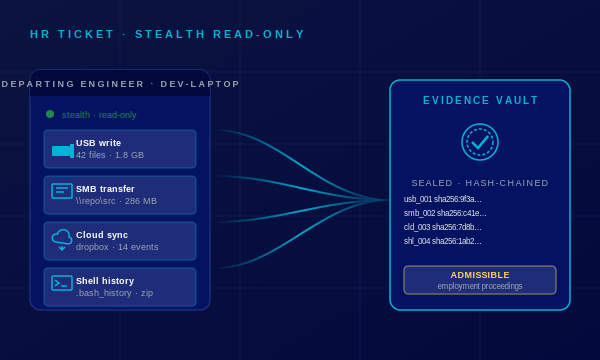
Stealth read-only laptop capture streaming USB, SMB, cloud sync and shell history into a sealed hash-chained evidence vault.

Scenario 02

Insider Threat Investigation

HR opens a ticket on a departing engineer with access to source repos. The PMAP agent runs in stealth read-only mode, captures USB write history, SMB transfers, cloud sync events and shell history, with a chain-of-custody hash chain that holds up in employment proceedings.

  • Read-only mode
  • Exfil timeline
  • Chain-of-custody
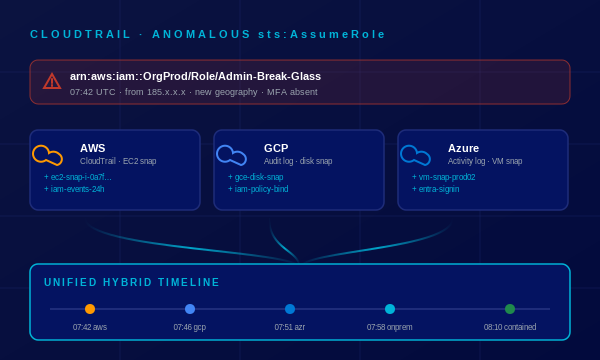
CloudTrail IAM alert pulling AWS, GCP and Azure evidence into a unified hybrid timeline ending in containment.

Scenario 03

Cloud Incident Response

An anomalous IAM role assumption surfaces in CloudTrail. The same PMAP console pulls control-plane evidence, snapshots affected EC2 hosts, runs the cloud-evidence detector library and ties findings back to the on-prem timeline, holding one investigation across hybrid infrastructure.

  • AWS + GCP + Azure
  • Snapshot + analyze
  • Hybrid timeline

Privia DFIR practice

PMAP · operated by Privia Security

  • 24/7 On-call response window
  • TR + EN Engagement reporting languages
  • Air-gap Sovereign deployment model
Chain of custody by design

The response practice behind the platform

Privia operates PMAP, and brings the investigators with it.

PMAP is built by Privia Security's DFIR practice, the same team that responds to incidents across the region's enterprises, runs compromise assessments for regulated industries, and hunts active adversaries inside large customer environments.

When an engagement starts, the platform and the practice arrive together. The investigators on the call are the people who shaped the artifact catalog, wrote the detectors and reviewed the case vault before it ever reached a customer.

  • Investigators on the ground across Türkiye, the EU and MENA
  • Engagement-grade reporting available in Turkish and English
  • Regulatory context across NIS2, KVKK and BDDK obligations
  • Air-gapped engagement model for sovereign environments

Plan a scoping call

Four capability pillars

Pick the engagement that matches the question on the table.

Most security questions belong to one of four engagement types: forensic reconstruction, active response, latent compromise discovery or proactive hunting. Each pillar carries its own scope, deliverables and engagement rhythm.

  • Pillar 01

    Digital Forensic Analysis

    Reconstruct what happened across hosts, cloud, mobile and network, with evidence that holds up under scrutiny. Suited to investigations where the question is what occurred, in what order, and who or what was affected.

    • Host forensics across Windows, Linux and macOS
    • Cloud and SaaS forensic reconstruction
    • Mobile and network forensic analysis
    Explore forensic analysis
  • Pillar 02

    Incident Response

    Contain, eradicate and recover from an active incident with a team that arrives with its own platform. Suited to organisations facing an active intrusion or preparing in advance through a retainer.

    • Emergency response on active incidents
    • Pre-engaged response retainer
    • Readiness assessment and post-incident hardening
    Explore incident response
  • Pillar 03

    Compromise Assessment

    Discover whether an undetected intrusion is already in the environment, and learn what to fix before it matters. Suited to organisations responding to a board question, an audit finding or pre-acquisition diligence.

    • Enterprise-wide compromise sweep
    • Cloud and identity compromise focus
    • M&A and targeted assessment variants
    Explore compromise assessment
  • Pillar 04

    Threat Hunting & Detection Engineering

    Move from reactive alerting to hypothesis-driven hunts, and keep the detections you build. Suited to mature SOCs and MDR teams investing in long-term coverage rather than point-in-time triage.

    • Hypothesis-driven fleet-wide hunts
    • Detection engineering as a service
    • Purple team validation and exposure programs
    Explore threat hunting

The service portfolio

Sixteen services across four capability pillars.

Each service below is a bounded engagement with defined scope, deliverables and a typical duration. Filter by pillar to see the engagements grouped by question type, or scan the full portfolio.

Built for enterprise scale

PMAP by the numbers

Three data points that describe how PMAP unifies vulnerability management across scanners, one data model and multi-tenant governance.

PMAP imports from every scanner to the same normalized standard, in real time over API sync or on a schedule. Integrity is enforced across the pipeline, and multi-tenant isolation keeps every subsidiary's data separate.

  • Hover for details
    30
    Vendor connectors and importers

    One platform, every scanner your program runs

    One platform unifies 30 vendor connectors across 9 categories, covering vulnerability scanners, DAST, SAST, SCA, ITSM and CI/CD. Results flow in over live API sync or scheduled imports, every finding is mapped to an asset and owner, and the correlation engine deduplicates across vendors.

    Tenable Qualys Rapid7 DAST, SAST and SCA
    Explore integrations
  • Hover for details
    48
    Product domains, one data model

    Findings, assets, projects and reports in one model

    PMAP spans 48 backend domains across finding lifecycle, assets, scanning, reporting, automation and tenancy, all on one normalized model. A finding moves from import to remediation without ever leaving the platform.

    Findings Assets Projects Reports Runbooks
    Explore the platform
  • Hover for details
    Multi-tenant

    One platform for the whole group and every unit

    A holding company and its subsidiaries share one platform with scoped data, a 10 by 6 role matrix, SLA thresholds and four-eye approvals. Group-level views roll findings and risk up across the entire organization.

    RBAC SLA Approvals Audit trail LDAP and MFA
    See access controls

Figures describe the PMAP platform across integrations, data model and multi-tenant governance.

How an engagement runs

Five steps from intake to handover.

Every engagement follows the same backbone. The depth of each step scales with the question on the table, but the shape stays predictable. The customer team knows what is happening, what is coming next and when each deliverable lands.

  1. Scope

    An initial scoping conversation defines the question, the affected surfaces and the success criteria. Engagement boundaries, access requirements and reporting cadence are agreed before any artifact is collected.

    Outcome Signed engagement scope and access plan.

  2. Collect

    The agent and API connectors deploy across the agreed surfaces. Artifacts are hashed at source, transported under mTLS and sealed into the case vault, with every transition logged for downstream review.

    Outcome Evidence baseline locked in the case vault.

  3. Analyse

    Investigators reconstruct the timeline, pivot across artifact families and map findings to MITRE ATT&CK techniques. Detector content surfaces the activity worth attention; the analyst decides what matters.

    Outcome Triaged findings and validated indicators.

  4. Report

    Findings land in two paired deliverables: an executive summary written for the board and a technical report written for the SOC. Both reference the same evidence trail, so the conversation stays grounded.

    Outcome Executive and technical reports delivered.

  5. Remediate and hand over

    Detection content, IOC sets and recommended controls move to the customer team. Where the engagement included remediation guidance, follow-up sessions track implementation through to coverage validation.

    Outcome Customer team owns the durable artifacts and content.

Common questions

Frequently asked questions.

What is the difference between incident response and a compromise assessment?

Incident response is engaged when an intrusion is known or strongly suspected and the priority is containment, investigation and recovery. A compromise assessment is engaged when the question is whether an undetected intrusion exists in the environment today; it is a planned, time-boxed sweep rather than a reactive activity.

Do you provide a SOC investigation platform, an incident response service, or both?

Both, delivered together. PMAP is the SOC investigation platform built by Privia Security's incident response practice. Engagements use the platform as their operational backbone, and customers can also license the platform for their own SOC to run continuous hunting and detection programs.

Can the platform be deployed in an air-gapped environment?

Yes. Air-gapped deployment is a first-class option rather than a workaround. The same agent runs as a standalone collector behind segmented networks, and the operator console can run inside customer infrastructure with no external dependencies. Sovereign and regulated environments use this model regularly.

Which operating systems and cloud platforms does the platform support?

Windows, Linux and macOS on the host side, with parity across all three for the artifact catalog. On the cloud and SaaS side, native connectors cover AWS, Azure, GCP, Microsoft 365 and Google Workspace, along with identity providers including Active Directory, Entra ID and Okta.

What region does the incident response practice serve?

The practice is built around enterprise customers across Türkiye, the EU and MENA, with investigators on the ground and engagement materials available in both Turkish and English. Engagements outside the primary region are evaluated case by case based on scope and timing.

Does the customer keep the detections built during an engagement?

Yes. Detection content authored during a hunt or detection engineering engagement (Sigma, YARA and Python detectors) is delivered as content the customer's SOC owns, not as a vendor-locked rule pack. The platform is one place to run those detectors, but they remain portable.

Recognition

Industry recognition and certifications.

PMAP and Privia hold a growing set of industry recognitions and certifications. This space updates as new badges are confirmed.

  • Industry recognition badge
  • Industry recognition badge
  • Industry recognition badge

Continue exploring

Reading paired with these capabilities.

Field notes, technical briefs and engagement breakdowns from the team behind the platform. Browse the full library or start with the three picks below.

Engage

Bring the platform and the practice into one engagement.

Whether the question is a planned compromise assessment, a retainer ahead of an unknown future or an incident already in motion, the right next step is a short scoping conversation. Tell us the shape of the question and the response team will route from there.

For active incidents, the response form below routes directly to the on-call investigators.